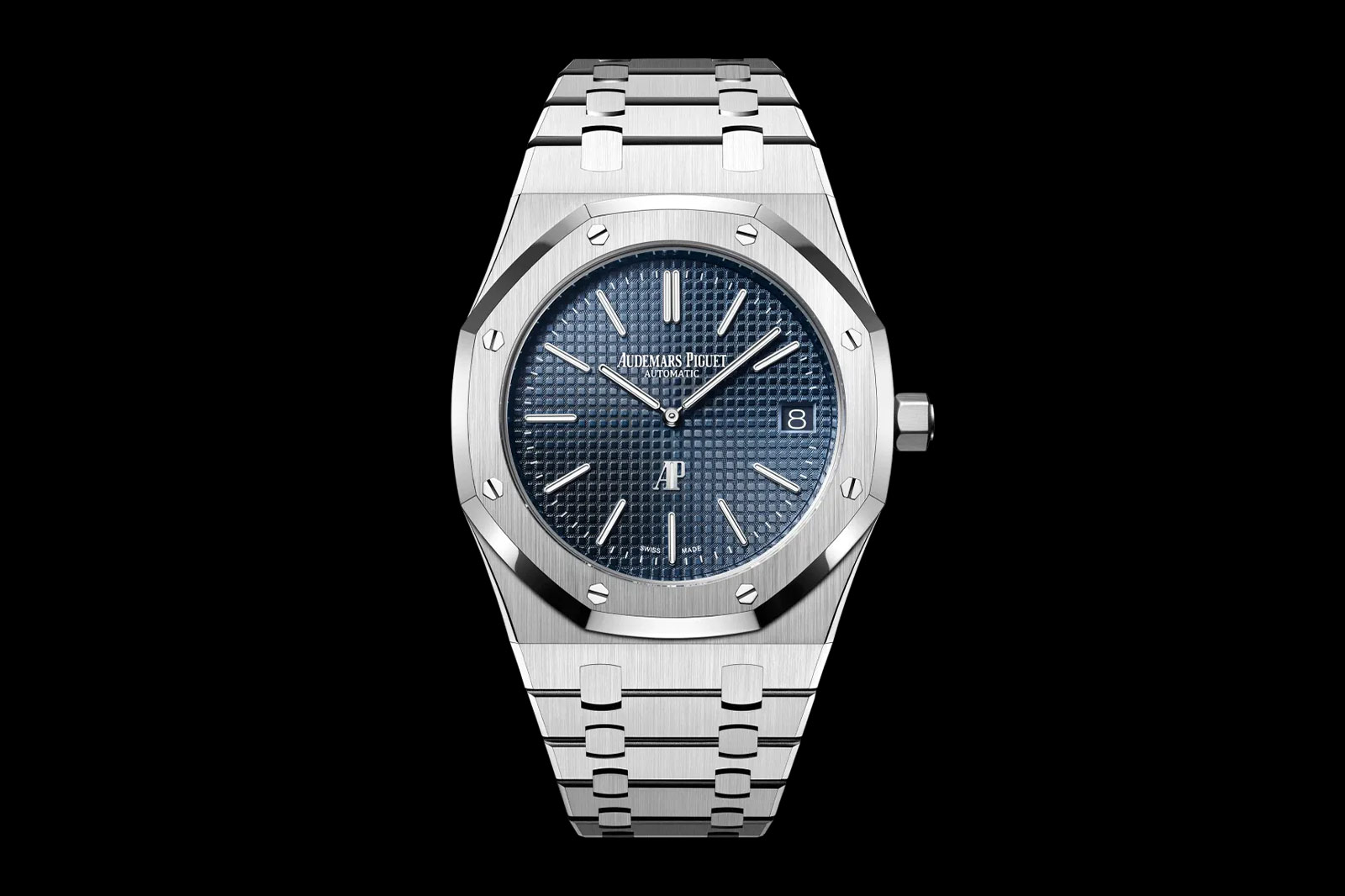
In 1972, Audemars Piguet launched a steel watch at the price of gold. The watch world was horrified. The watch — designed by Gerald Genta, the same man who would later design the Nautilus — was made from stainless steel, had an integrated bracelet, and cost 3,300 Swiss francs: the equivalent of a gold dress watch from one of the grand Geneva houses. Nobody understood it. Some important people hated it. Genta later said it was the best work of his life. He was, as was often the case, correct.
The Story
The origin story of the Royal Oak is inseparable from the 1972 Basel watch fair. Audemars Piguet's president Georges Golay needed something extraordinary — their company was in financial trouble, and the watch industry was in the middle of the quartz crisis that would eventually destroy hundreds of Swiss manufacturers. Genta was approached on a Sunday, given until Monday morning. He sketched the Royal Oak from memory — octagonal bezel, exposed screws, integrated bracelet, "tapisserie" dial — drawing from the shape of the porthole screws on ships. In 1972, the reference 5402 changed everything. In 1997, the reference 15202 — the "Jumbo" — refined everything. This is the watch that defines the genre. Every casino-floor chronograph complication is measured against what it achieves.
The Mechanism
The calibre 2121 is perhaps the most elegant automatic movement ever put into a sports watch. Ultra-thin at 3.05mm, it allowed Genta's case design to remain remarkably slim for a watch of its presence. The movement runs at 19,800bph — slower than contemporary movements, which means it requires service less frequently — and delivers a 40-hour power reserve through a peripheral rotor that winds the mainspring without the central mass of a conventional rotor. The movement is finished to a standard that rewards examination: côtes de Genève, bevelling, and polishing that would be acceptable in a pocket watch and is extraordinary in a sports timepiece.
On the Wrist
Thirty-nine millimetres is the Royal Oak's traditional size — the reference 15202 does not bow to contemporary demands for larger cases. It sits correctly on a medium wrist and slightly small on a large one. The tapisserie dial — a relief pattern produced by pressing, not printing — changes appearance entirely depending on the angle of light. In a watch with no luminous material and no chronograph function, this is the primary source of visual interest. It is inexhaustible. You will look at this watch daily for a decade and see something new in it each time.
“You will look at this watch daily for a decade and see something new in it each time.”
How to Acquire It
The reference 15202 "Jumbo" was discontinued in 2019 and replaced by the 15202ST. New examples can be purchased through Audemars Piguet boutiques directly — the waiting list for the standard steel/blue configuration is 12 to 24 months. Pre-owned examples trade at 30–50% above retail, reflecting sustained demand for the original Jumbo proportions. The brand also operates AP House, their private client service, which occasionally offers allocation to collectors with existing purchase histories. For pre-owned 15202, specialist dealers and the major auction houses offer authenticated examples. The calibre 2121 — shared with Patek's calibre 2121 — requires service every 8–10 years; factor this into purchase decisions.
- →New purchase through AP boutique is the cleanest route; join the allocation list immediately.
- →The blue dial on stainless steel (15202ST.OO.1240ST.01) is the quintessential configuration.
- →For immediate acquisition, specialist pre-owned dealers and the major auction houses offer authenticated examples at a premium.

