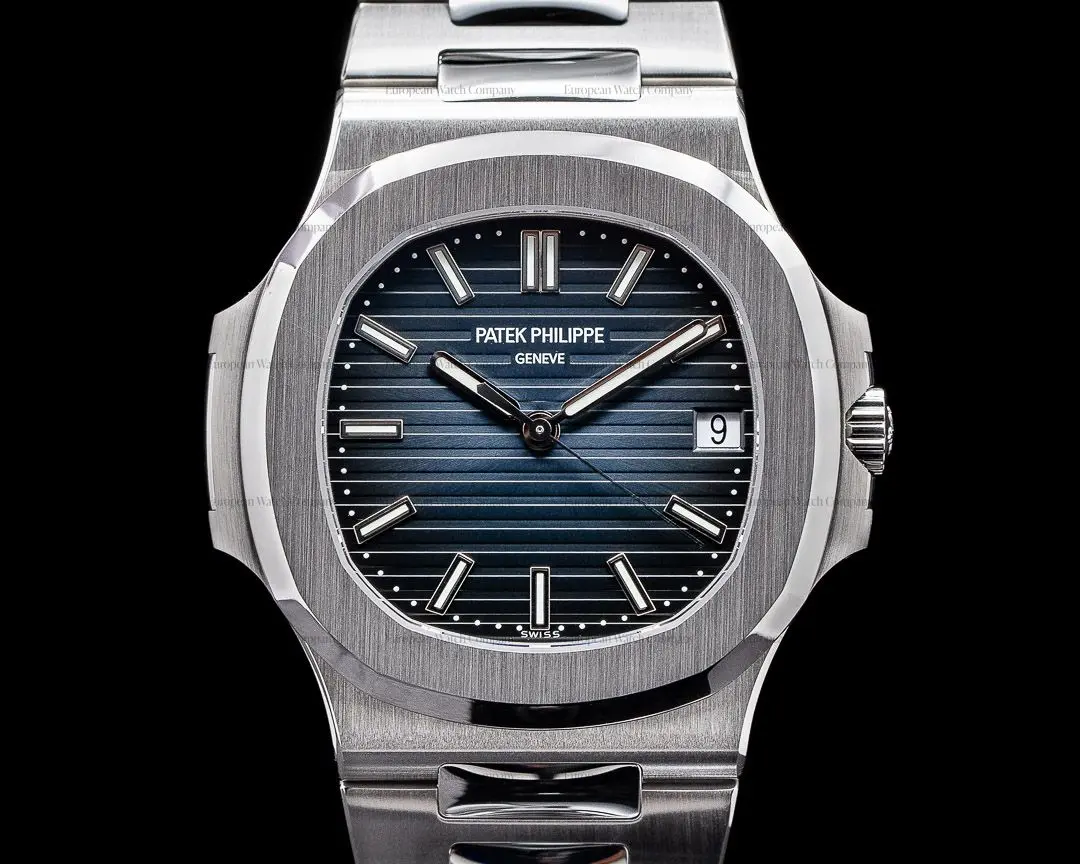
In January 2021, Patek Philippe announced the discontinuation of the Nautilus reference 5711 in steel. The retail price had been $34,893. Within 24 hours of the announcement, pieces on the secondary market reached $120,000. By summer 2021, the last examples were trading above $150,000 at auction. Patek did not announce this outcome with any particular satisfaction. They did not need to. The 5711 had already become what every true collector had always known it to be: the benchmark. The casino chip that every other chip is compared to.
The Story
Gerald Genta designed the Nautilus in 1976, in a single evening, on a napkin, at the behest of Patek Philippe's then-CEO Henri Stern. It was an outrage. A steel sports watch from the house that had defined Swiss luxury for over a century, priced identically to Patek's gold models. The market didn't know what to do with it. For years the Nautilus languished. Then, slowly, it found its people. By the 2010s the 5711 had become the most desired watch in the world — not among all watch buyers, but among the buyers who mattered. The casino analogy is apt: the 5711 is the chip that signifies you know what you're playing for. The reference 5726 Annual Calendar, the 5726A — these are serious chips. The 5711 is the one you show first.
The Mechanism
The calibre 26-330 S C is a 5.35mm-thick automatic movement with Spiromax balance spring — a silicon-based material that renders the watch immune to magnetic fields and immune to temperature variation. It oscillates at 28,800bph and delivers 45 hours of power reserve. In a world of tourbillons and skeletonised complications, these numbers are deliberately modest. Patek's argument has always been that the 5711's complication is its lack of complication: every finishing decision, every bridge, every micro-rotor, is perfect. The movement is Geneva Seal certified. It is not the most interesting movement ever built. It is the most accomplished.
On the Wrist
Forty millimetres is not a large watch, but the Nautilus wears large — the integrated bracelet, the horizontal lines of the dial, the octagonal bezel all create a sense of presence disproportionate to the case diameter. The bracelet, with its signed clasp and alternating polished and brushed links, is widely regarded as the finest bracelet in production watchmaking. On the wrist, the watch becomes a part of the wrist — the integration is so complete that you stop noticing it's there. This is both the highest compliment in watchmaking and, perhaps, the reason people want it so desperately.
“Not the most interesting movement ever built. The most accomplished.”
How to Acquire It
The 5711 is no longer in production. Any piece you acquire will be pre-owned, and the price will reflect both the rarity and the condition. Christie's, Phillips, and Sotheby's conduct quarterly watch auctions in Geneva where 5711s occasionally appear; prices have stabilised in the $100,000 to $140,000 range since the initial discontinuation spike. Reputable specialist dealers carry pre-owned examples with authentication documentation — always request written verification. Avoid private sales without independent authentication. The 5711 has been extensively faked; the movement and bracelet are the primary authentication points.
- →Buy only with Geneva Seal certification documentation and original box/papers.
- →Christie's and Phillips Geneva auctions have the best selection and most rigorous authentication.
- →The olive dial variant (5711/1A-018) commands a 20–30% premium over standard blue/black dials.